
Why Website Design and SEO Should Be Done Together (And Why Most Designers Get This Wrong)

Here's something I see way too often: someone invests thousands in a gorgeous website redesign, launches it with excitement, and then... crickets.
Beautiful site, zero traffic.
Or worse-they hire an SEO expert months later who tells them the whole thing needs to be restructured because the foundation is wrong.
Sound familiar? That sinking feeling when you realize your pretty website isn't actually working for your business?
The Truth Most Designers Won't Tell You
TL;DR: Website design and SEO aren't separate projects - they're two sides of the same coin. When done together from day one, you get a site that's both stunning AND shows up on Google. When done separately, you're either stuck with a beautiful ghost town or decent rankings with a site that makes visitors run away.
But here's what most people miss:
SEO isn't something you sprinkle on top after design is done-it fundamentally shapes site architecture, page structure, and content strategy
Most "SEO services" added after launch costs more and set you back compared to building it in from the start
The design decisions you make on Day 1 (URL structure, image optimization, mobile responsiveness) either set you up for SEO success or can create expensive fixes
As a website designer and SEO strategist who has designed 80+ websites for coaches and creatives, I can spot a "design-first, SEO-later" disaster from a mile away.
Let me break down exactly why this happens and what to do instead.
The Design-First Disaster: What Really Happens
You've probably heard the advice: "Get a beautiful website first, then optimize it for search." Sounds logical, right?
Wrong. So wrong.
Here's what actually unfolds when you separate design and SEO:
Your designer creates a stunning site focused purely on aesthetics.
They build pages with minimal text because it "looks cleaner" (Google needs substantial content to understand what you do).
They create a beautiful image-heavy portfolio with zero alt text or resizing (goodbye, Google Image Search traffic or fast load speeds).
They don’t advise on any SEO keyword research and set up your title tags and meta descriptions with random phrases or overstuff with variations of keywords (not a good look)
Then you launch. You're proud. It's gorgeous. You share it everywhere.
And... nothing. No organic traffic. No inquiries from Google. Just expensive ad spend trying to drive traffic to this beautiful website that Google basically can't see.
I’ve had many clients who came to me for SEO fixes after design, and they end up having to spend $3,000+ and some of the design has to be redone with new sections. They end up telling me "I wish I'd known this before I spent $5-8K on design."
The most frustrating part? That URL structure your designer set up? Changing it means losing any SEO equity you've built and setting up redirects. Those image-heavy pages? Those images need to be re-added and optimized. It’s double work when it could’ve been done the first time around.
Want to avoid these common website mistakes? The key is bringing SEO into the conversation from the very beginning-not as an afterthought when you realize your beautiful site isn't getting found.
And if you’re looking for a website redesign and you already rank high on Google, check out this resource to make sure you don’t lose your rankings during an overhaul.

Why SEO-First-Then-Design Fails Too
Okay, so flip it around-hire an SEO expert first, get your strategy, then design, right?
Also wrong. Here's why:
SEO experts who don't understand design often create technically perfect sites that look like they're from 2010. They'll pack every page with keywords until it reads like robot gibberish. They'll insist on long-form blog posts on every page because "Google likes content" without considering how that destroys your visual hierarchy and user experience.
I've had clients come to me after working with SEO-only consultants who left them with sites that ranked decently but converted terribly. Sure, people were finding them on Google-and then immediately bouncing because the site felt spammy or outdated.
The real-world reality: Your website has two jobs-get found AND convert visitors into clients. An SEO-first approach nails the first job and completely bombs the second. And what's the point of ranking on page 1 if everyone clicks away the moment they land on your site?
Plus, here's something most SEO-only folks won't tell you: Google's algorithm has evolved.
They're not just looking at keywords anymore-they're evaluating user experience metrics like time on site, bounce rate, and mobile usability. A poorly designed site will tank your SEO eventually, no matter how many keywords you stuff in there.
The Magic That Happens When Design and SEO Work Together From Day One
This is where things get exciting. When you approach website creation with both design and SEO baked in from the start, you unlock something powerful: a site that's strategically structured, visually stunning, AND optimized to be found.
Let me paint the picture of what this actually looks like:
Site Architecture Built for Both Humans and Google
Your site structure isn't just about what pages look good in the navigation-it's mapped to how your ideal clients actually search. We're creating pages that target specific search queries while taking users on a logical journey that builds trust and leads to conversion.
For example: Instead of a generic "Services" page, we might create separate pages for "Business Coaching for Photographers" and "Personal Brand Photography for Creatives" - each optimized for different search terms while maintaining your cohesive visual brand. This isn't just better for SEO-it's actually better for users who can immediately tell if you serve their specific needs.
If you're a coach or service provider, check out these 9 essential website pages that should be part of your site structure from the start.
Content Strategy That Serves Both Purposes
When design and SEO collaborate from the start, your copywriter (or you) knows exactly how much content each page needs, which keywords to naturally weave in, and how to structure that content so it's both scannable for readers and optimized for search engines.
You're not cutting valuable content because the designer wants a "cleaner look." Instead, you're creating content blocks that are visually appealing and SEO-friendly from the get-go.
My SEO copywriting checklist walks through exactly how to write content that ranks AND converts-because you need both to make your website investment pay off.
Technical Foundation That Doesn't Need Fixing
This is huge. When SEO is involved from Day 1, all the technical stuff happens correctly the first time:
URL structures are set up strategically (not randomly)
Image file names and alt text are optimized before upload
Page load speed is prioritized in design decisions
Mobile responsiveness is tested with SEO tools, not just eyeballs
Meta descriptions are written alongside page content
Schema markup is implemented during build, not added later
Internal linking structure is mapped strategically
What most people miss here: These aren't "nice to have" extras-they're the foundation. Trying to fix these after launch is like trying to add a basement to a house that's already built. Technically possible, but expensive and disruptive.
Want to see all the SEO elements I implement on every website? Understanding these from the start saves you months of costly retrofits later.
Real Results: What Actually Changes
Let me get specific about what happens when design and SEO work together, based on actual client results:
Jennifer (wedding photographer) came to me with 0 rankings and in need of a design overhaul. Within one week of launching her redesigned site with SEO baked in, she got her first couple inquiries from Google for clients searching for services in her area. (You can see her full website transformation here!)
Here’s a snippet of our project together:
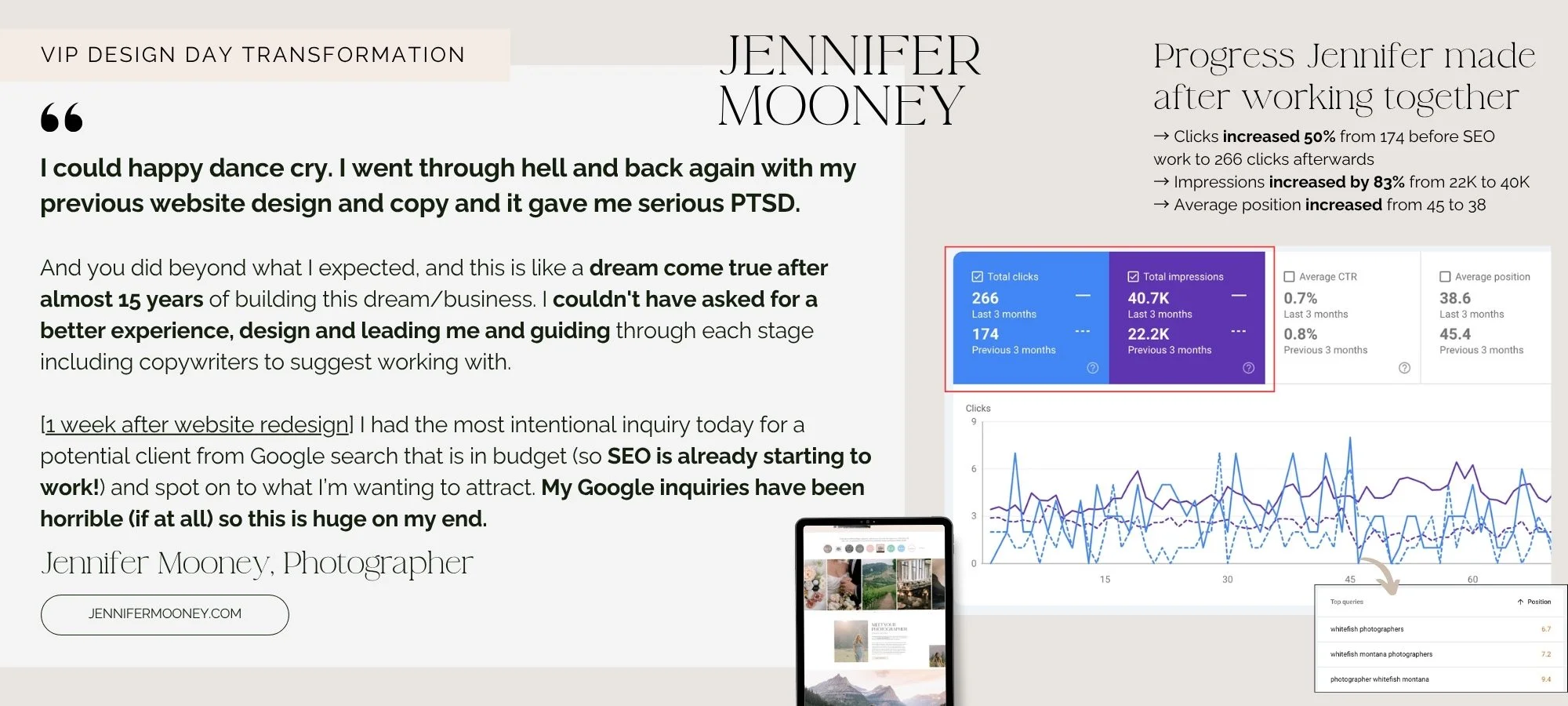
The pattern I see across all 80+ websites I've designed: When clients invest in integrated design + SEO content strategy from the start, they typically see:
Page 1 Google rankings within 4-12 weeks (not months or years)
10-200% increase in organic traffic within 6 months
Higher conversion rates because the design guides visitors toward action while the SEO attracts the right people
Check out this SEO case study showing a 200% increase in keywords to see what's possible when you get the foundation right from day one.
The "But I Don't Have Time" Myth
I know what you're thinking: "This sounds great, but doesn't adding SEO to the design process make everything take forever?"
Actually, no. And here's why that assumption is backwards:
Timeline comparison based on client projects:
Separate approach: 3-4 weeks for design + 1-2 months for SEO retrofit = 4-6 weeks total
Integrated approach: 1-2 days for design + SEO together = Done in under 1 week
The integrated approach front-loads the strategic thinking, which means the execution is cleaner and faster. Plus, you launch a site that's actually complete-not a beautiful shell waiting for SEO to make it functional.
The VIP Day model makes this even more dramatic: I can complete both design and SEO strategy in 1-2 intensive days because we're not waiting weeks between designer feedback and SEO recommendations.
Everything happens simultaneously, decisions are made in real-time, and you walk away with a finished, optimized site ready to start ranking.

Common Mistakes Even "Integrated" Approaches Make
Here's where it gets nuanced. Some designers claim to do SEO, but they're really just checking boxes without strategic implementation. And some SEO experts offer design services that... well, let's just say they shouldn't.
Red flags that someone doesn't actually integrate design + SEO:
They treat SEO as a checklist, not a strategy
Real integration means your SEO specialist is involved in conversations about site architecture, page layout, and content strategy-not just filling in meta descriptions after everything's designed. I've seen too many designers who think addingtechnical SEO changes at the end counts as "doing SEO." It doesn't.
They can't explain how design decisions impact SEO
Ask any designer who claims to do SEO: "How do you pick the keywords for the website?” or "How should I set up my pages for SEO visibility?” If they can't give specific answers, they most likely don’t have proper experience.
They separate the team
Even if the same company offers both services, if your designer and SEO specialist aren't talking to each other regularly throughout the project, you're just getting two separate services sold as one package.
They add SEO at the end of the design process
If the SEO strategy conversation doesn't happen until after the design mockups are approved, it's too late. SEO should be influencing those mockups from the start.
They don't customize based on your business model
A photographer's SEO strategy looks different from a business coach's strategy, which looks different from a wedding planner's. If someone's using the exact same SEO template for every client, they're not actually strategizing.
What Makes Someone Qualified to Do Both
Not every designer should be doing SEO. And not every SEO expert should be designing websites. So what makes someone qualified to integrate both effectively?
The skill overlap that matters:
Understanding of information architecture (how content is organized)
Knowledge of user experience principles (how people move through sites)
Technical literacy (how websites actually work under the hood)
Strategic thinking (how to connect business goals to design + SEO decisions)
Copywriting awareness (how words work for both humans and search engines)
My specific background that makes this work: I’ve been doing SEO since 2016 (including 3 years at agencies supporting billion-dollar brands) + 80+ websites designed specifically for coaches and creatives. I'm not a designer who dabbles in SEO or an SEO specialist who slaps together website templates. I've built my entire business model around the integration of both disciplines because I've seen how powerful it is when done right. Here's why I decided to offer both services instead of choosing one lane.
What to look for in a provider:
Portfolio showing both design aesthetics AND measurable SEO results
Ability to explain technical SEO concepts in terms of design impact
Process that involves SEO strategy before design mockups are finalized
Case studies with both visual transformation AND ranking improvements
Understanding of your specific industry's search landscape
And honestly? If you're a web designer reading this and thinking "maybe I should add SEO to my packages," check out my post on SEO for web designers - because done wrong, you're doing your clients a disservice.
Making the Decision: What's Right for Your Business Right Now
Let's get practical. You're reading this because you need to make a decision about your website. Here's how to think through your options:
You might be ready for an integrated design + SEO approach if:
Your business is established (you're past the MVP stage)
You're ready to invest in long-term visibility, not just quick fixes
You've outgrown your DIY website and need professional positioning
You're willing to prioritize strategy over speed-to-launch
You understand that SEO is a 3-6 month game that requires ongoing blog content, not an overnight miracle
You might need design first, SEO later if:
You're genuinely launching tomorrow and need something online NOW
Your business model or target market is still shifting significantly
You don't have budget for a comprehensive approach and need to phase investments
You might need SEO rescue if:
You already have a recently designed site that's not performing
Your design is solid but you're getting zero organic traffic
You're willing to potentially restructure elements of your current site
Real talk: If you're reading this and thinking "I just need a quick website to get started," that's valid-but know that you'll likely need to rebuild or heavily modify it within 12-18 months as your business grows. Sometimes that's the right trade-off. Just go in with eyes open about the future investment required.
Still trying to decide when to hire a professional website designer versus DIY? Or wondering how long it actually takes to DIY your website? These resources will help you make the call that's right for where you are right now.

Your Website Should Work as Hard as You Do
Here's what I want you to walk away understanding: your website isn't just a digital business card. It's not just a place to send people who ask for your link.
It's a 24/7 team member that should be actively attracting your ideal clients, positioning you as the obvious expert, and converting visitors into bookings while you sleep.
But that only happens when design and SEO work together from the start.
When you separate them, you end up with a site that's either beautiful but invisible, or visible but not compelling. Neither option serves your business. Neither option justifies the investment you're making.
The coaches and creatives I work with - the ones who've outgrown their DIY websites and are ready for a professional online presence that matches their elevated expertise - they don't want to piece together their website over 6 months.
They don't want to hire three different people who don't talk to each other. They want someone who can see the big picture and execute it efficiently.
That's exactly why I created the VIP Design Day model: complete website transformation in 1-2 intensive days, with both web design and SEO strategy baked in from the start.
No months-long projects.
No expensive retrofits.
Just strategic implementation that gets you ranking AND converting from day one.
Because you've worked too hard to build your expertise and grow your business to let a disconnected website hold you back.
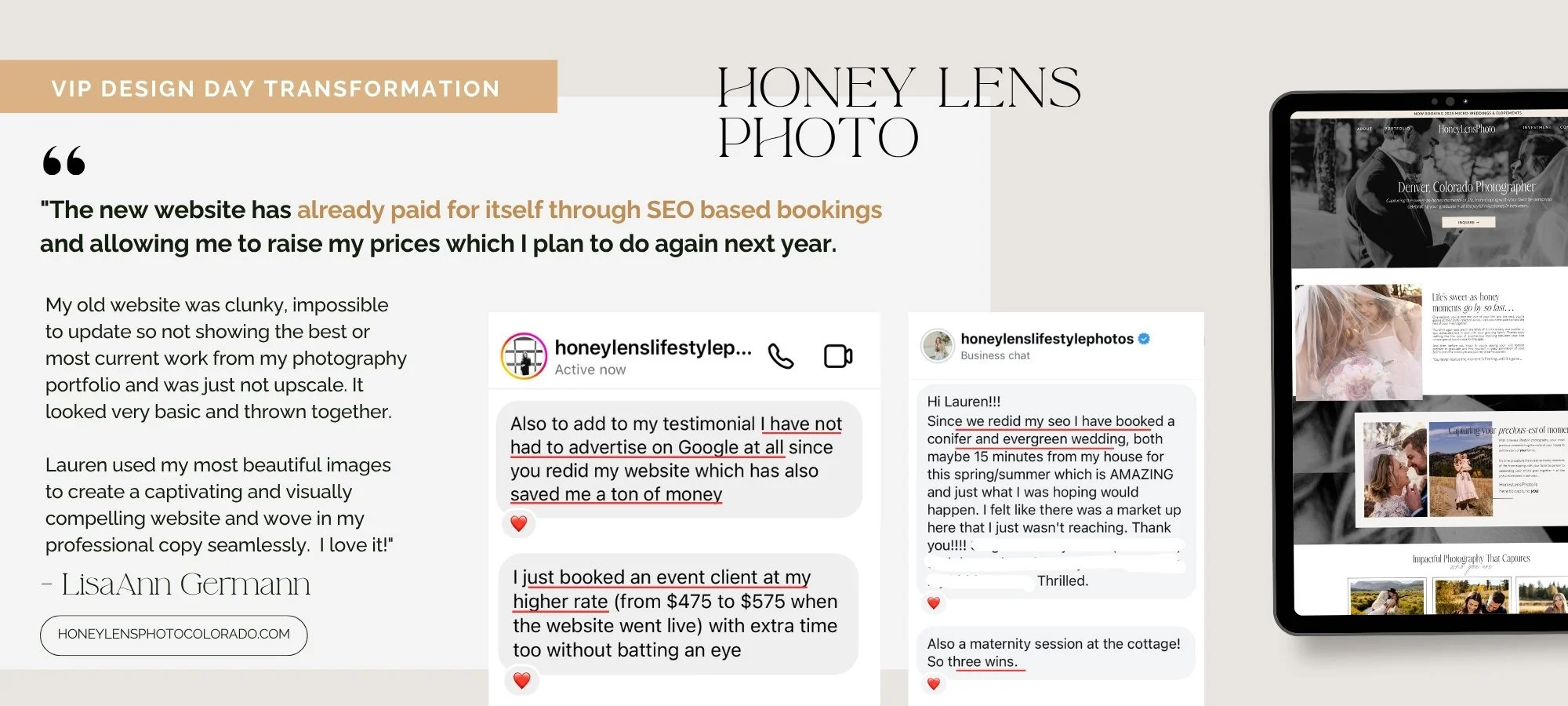
Clients like LisaAnn not only attracted higher budget clients, but also made her money back and raised her rates because she got booked out.
Ready to Build It Right From the Start?
If this resonates with you-if you're tired of websites that are either pretty OR functional, but never both-let's talk about your VIP Design Day.
Here's what makes it different:
Both design and comprehensive SEO strategy completed in 1-2 intensive days
Real-time collaboration via Slack so you see your site come to life as we work
Strategic implementation based on 10 years of SEO experience and 80+ client websites
You walk away with a complete, optimized site ready to rank and convert
30 days of post-launch support included because I'm invested in your success
You're ready for a VIP Design Day if:
You've outgrown your DIY website and need professional positioning
You're an established coach or creative serving premium clients
You want to invest in long-term visibility, not just social media hustle
You're ready to make decisions and take action quickly
You value expert guidance over figuring it out yourself
I only take 3-4 VIP Day clients per month so I can give each project the strategic attention it deserves. If you're ready to partner with an SEO web designer for a website that works as hard as you do, let's make it happen.
Looking for more blogging and SEO tips? Check out these blog posts:
